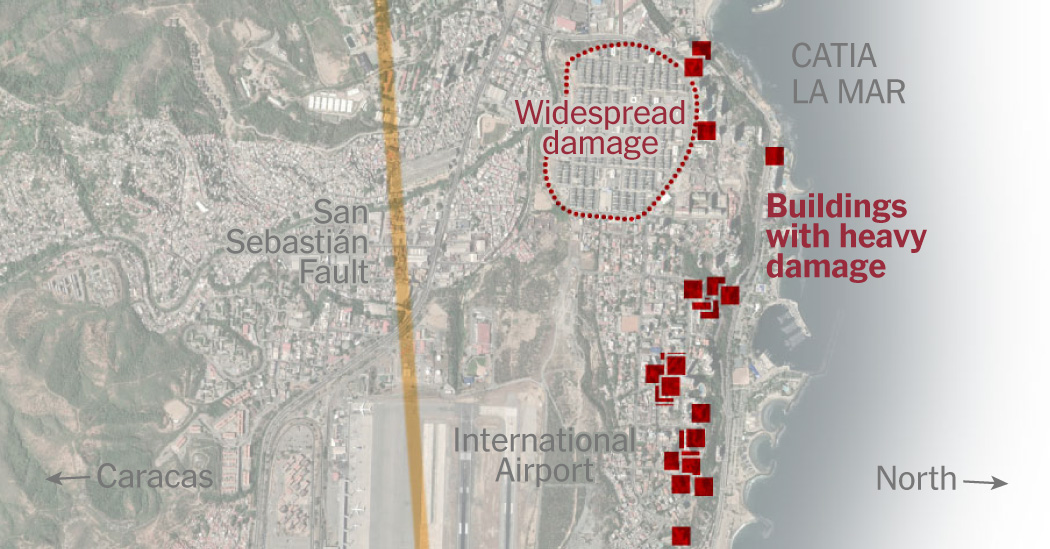
This early assessment of the scope of the destruction is based on a New York Times analysis of satellite imagery, photographs, video and verified social media posts from the area. The full scale of damage is likely to be greater, and will only emerge in the coming days and weeks.
Many people and goods enter Venezuela through La Guaira, via the country’s main airport or one of its largest ports. Resorts, hotels and apartments sit atop seaside cliffs, offering panoramic views of the Caribbean Sea.
But this beautiful coastal state, which is less than 100 miles east of the epicenter and close to a major fault line, now lies in ruins. Roads are cracked, apartment buildings turned into skeletons. More than a hundred buildings have collapsed in La Guaira, according to the United Nations’ main humanitarian agency. Many people are missing or trapped under rubble.
As of Friday afternoon, 920 people have been killed. The death toll is expected to rise.
Satellite images show the severity of the destruction in Catia La Mar, a city next to Simón Bolívar International Airport, the main hub serving Caracas, the capital. In this image, multistory buildings perched along a beachfront ridge have collapsed entirely.
Just north of the airport, another set of apartment buildings sitting atop a cliff above the beach suffered the same fate.
Nearby, in a planned neighborhood with hundreds of identical low-rise apartments, some buildings have completely collapsed, and many others sit wildly askew.
This area was built in the early 2010s during the presidency of Hugo Chávez as part of a nationwide social housing program. Many residents relocated here after surviving horrific mudslides in 1999 that killed tens of thousands. Now, they find themselves facing another disaster.
Many residents are searching for their loved ones on their own. Experts say that the first 24 to 48 hours after a quake are the most crucial for finding survivors.
Venezuela’s public services are weak after more than a decade of economic crisis. Transportation closures, power outages and communication disruptions have made it harder to deliver aid. Gas and water services have also been disrupted in parts of La Guaira, according to the government.
The U.S. and various Latin American countries have offered to help, sending humanitarian aid and rescue workers. Aid organizations are preparing to provide for the basic needs of up to 200,000 people.